
One team deploys a feature for QA. Another needs to test a migration. Product wants a stable demo. Each request makes sense. A single shared environment forces them into the same queue.
We have seen one deployment overwrite another, testers wait for a stable slot, demos block development work and teams lose track of which revision is running.
The name varies between teams: staging, stage, dev, test or UAT. We use shared staging to mean any environment where several changes have to take turns.
When several decisions wait for the same environment, they have to happen one after another. Engineering, QA and product repeat tests, screenshots and approvals, coordinate deployment windows and wait longer to move a change forward.
Extra permanent environments rarely clear that queue. A reviewable environment has one job: help someone make a specific decision about a known version of a change.
The delivery bottleneck
Shared staging slows down when reviews run in parallel.
Waiting and unclear targets cause the delay. A team loses confidence in a review when the target changes underneath it.
Changes collide
A newer deployment replaces the version somebody else is still testing.
Review waits
QA, product and engineering negotiate for a stable window instead of reviewing the work.
Results become unclear
A test result or screenshot may no longer match what is currently deployed.
Follow the waiting time
Measure the wait as part of delivery time.
A staging queue often starts before the deployment metrics begin. We look at how long a change waits for its first useful review, how much work is repeated and how often a newer deployment makes earlier results out of date.
Review delay
Track the median time from ready for review to the first useful validation.
Time spent waiting
Record engineering, QA and product hours spent waiting, coordinating or repeating work.
Repeated review work
Count tests, demos and approvals that need to be repeated after a newer deployment.
Give each review a clear target
Build the smallest environment the review needs.
A reviewable environment has a clear purpose, a known source revision, an owner, clear rules for test data, visible health and a cleanup rule. It only needs the parts required for that decision.
A preview environment gives developers, testers, product teams and stakeholders their own reviewable version of a change. They can develop, test and demonstrate it without competing for shared staging.
When previews reuse existing Kubernetes capacity and shared platform services, the extra running cost can stay low. A short-lived namespace uses the cluster and services that are already running.
That changes when a preview needs dedicated nodes, databases, load balancers, large data sets or a long lifetime. Clear resource limits and automatic cleanup after a set time help keep costs under control.
Match the environment to the decision
Preview, UAT and shared staging answer different questions.
Each stage supports a different kind of review.
Preview environment
Review one meaningful change quickly and in isolation.
Coordinated UAT
Test a fixed combination of services, repositories or business flows.
Shared staging
Keep it for final release checks and tests that need the full system in a common state.
A controlled GitOps loop
Record each step from creation to deletion.
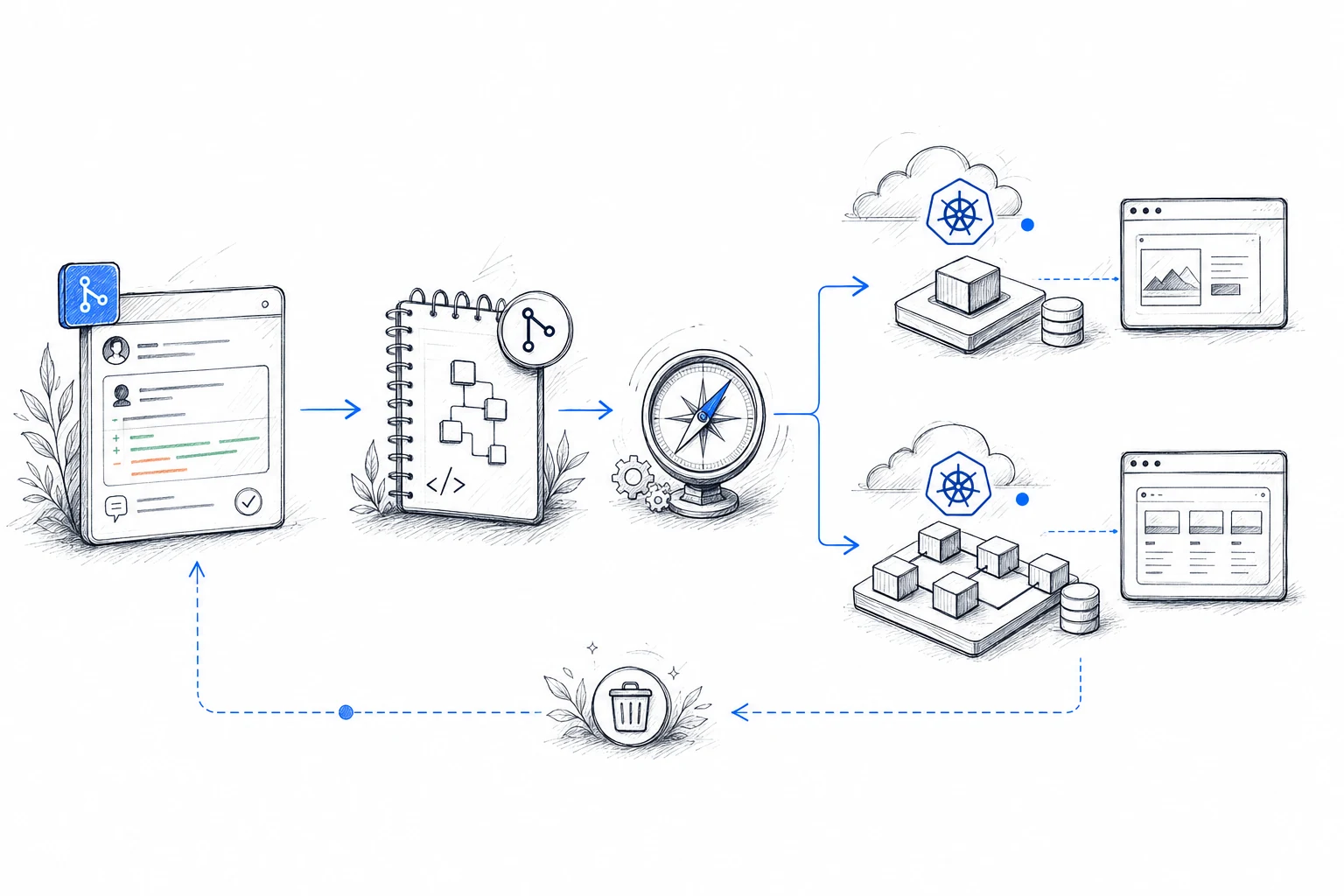
A pull request records the change. CI builds a fixed application version. Git records how the environment should be set up. Argo CD applies that setup and keeps it in sync. The URL, version, health and test results return to the pull request.
When the change is merged, closed or reaches its time limit, the environment definition is removed and the environment is cleaned up. Git history and review results remain available.
- Start with the workflow that waits for shared staging most often.
- Build one complete create, update, review and delete lifecycle.
- Measure waiting time, failed environments and old environments that were not removed before adding more teams or services.
A 30-day decision
Fund one review path, then decide from the results.
Choose one staging bottleneck where work regularly waits or needs to be repeated. Run a 30-day pilot, then decide whether the team should spend more time and money on it.
Baseline
Measure the current wait, repeated work and environment cost for one review path.
Pilot
Build one complete create, update, review and delete lifecycle using the existing delivery controls.
Decide
After 30 days, extend, adjust or stop based on review delay, repeated work, stability and AWS spend.
Where to start
Start with a review that regularly waits.
Find the change that repeatedly waits for staging, give it one controlled review path and measure whether the queue gets shorter.
Shared staging keeps a clear job: final release validation and shared checks. Preview and UAT paths handle review work that needs isolation.
References and related resources